What Noah a Harvard Graduate taught me about Deep Listening
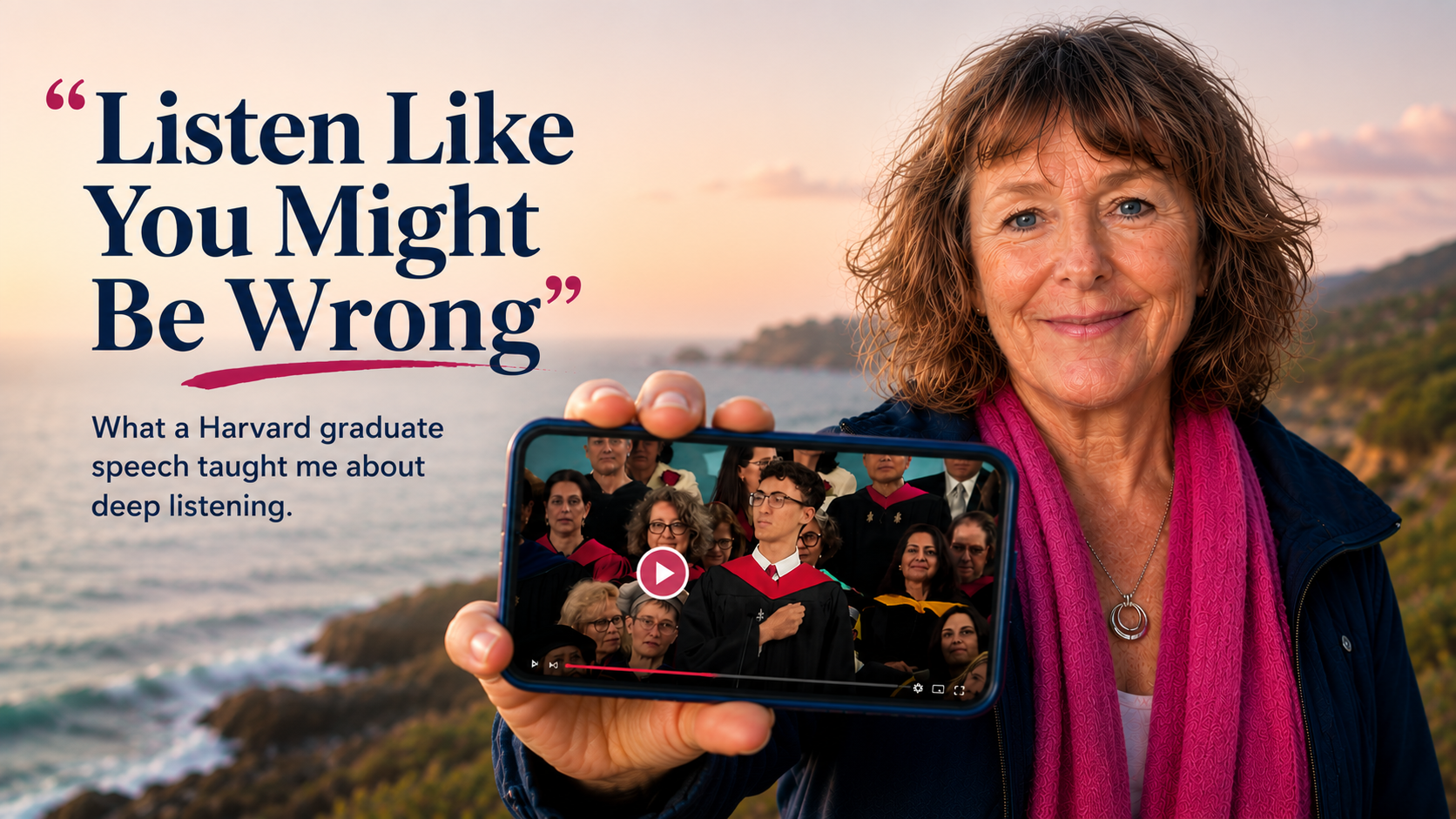
Listen Like You Might Be Wrong - A Harvard Student's Speech and the Practice of Deep Listening
I came across a video this week that stopped me completely.
I wasn't expecting it. I was just scrolling - the way you do - and then I stopped to listen to a video by a young Harvard graduate say something I have believed for a long time but never heard expressed quite so beautifully.
His name is Noah Eckstein. He gave his address at Harvard on 28 May 2026. And in the middle of a world that feels more divided than ever - at a university in the middle of its own fierce political battle - he stood up and said something that cut through all of it.
"Listen like you might be wrong."
Four words. And I haven't been able to stop thinking about them since.
The Story That Made Me Cry
Noah's life, he told the audience, begins like a joke.
One grandfather: a Pakistani Muslim who lived through the Indo-Pakistani War of 1947. The other: a Jewish refugee of the Holocaust.
Two men from opposite sides of some of the most painful divisions in modern history.
And one of Noah's core childhood memories was watching them sit together at a coffee table - discussing everything under the sun. Calling his parents. Always asking, at the end of every phone call, how the other one was doing.
They never resolved their differences. They were both stubborn. They held their own beliefs and traditions until the very end.
But they acknowledged each other.
They cared for each other.
And at the end of their lives, they were proud to be of one family.
Noah's point - and it is devastating in the best way - is that this was not passive. It was not comfortable. It was not a compromise. It was a choice, made again and again, to keep the other person human.
"Their differences remained a point of contention, not a point of division."
Why This Moved Me So Deeply
I've spent more than 20 years sitting with people - holding space for people through their hardest moments.
And in all that time, I've noticed something. The most painful experiences people carry aren't usually caused by strangers. They're caused by the people they love. The people they're in relationship with. The people across the coffee table.
And so often, the thing that broke the relationship wasn't the difference itself.
It was the moment when the other person stopped being a person - and became an obstacle.
Noah names this so precisely. He says that when we stop genuinely listening, the person across from us becomes something to overcome, to silence, to defeat. And the moment that happens - something irreplaceable is lost.
I know this in my bones. Because I've lived it many time.
Deep Listening - and Why It Takes Work
In my Joyful Living framework, I teach something I call Deep Listening. It lives in Pillar 2: Centring - the practice of connection.
And when I teach it, I always tell my clients: this is not the soft work. This is not the easy work.
Deep Listening is not nodding politely. It is not waiting for your turn to speak. It is not tolerating someone else's view while quietly composing your rebuttal.
Deep Listening is the willingness to be changed by what you hear.
Noah says it even more directly. He says that to truly listen, you often have to fight yourself first. Your own urge to win. Your own need to be right. Your own fear that if you really hear the other person - if you really let their humanity land - you might have to hold your own beliefs more lightly than you'd like.
That is terrifying. And it is also the only way through.
The Practice Noah's Harvard Speech Left Us With
At the end of his speech, Noah offered one simple practice for going out into a divided world:
When you meet someone you disagree with - state your case. Stand up for what you believe in. But then ask them about their beliefs. Ask how they got there. Place yourself in their shoes. Ask yourself: why might I believe this, if I were them?
"Listen like you might be wrong. It's not a weakness or a betrayal of your own ideals. It's the hardest and most important thing you can do."
He is not asking us to abandon our values. He is not asking us to pretend that harmful things are not harmful. He is not asking us to give a platform to cruelty.
He is asking us to stay curious about the human being in front of us.
To ask: how did they get here? What have they lived through? What would I believe, if I had walked their road?
That question - genuinely asked - is an act of radical connection
What This Means for a Joyful Life
Here is what I know after decades of this work:
The quality of your life is shaped - more than almost anything else - by the quality of your connections.
Not the number of them. The quality.
And connection requires a particular kind of courage. The courage to stay present with someone even when they challenge you. To let go - even briefly - of the need to be right. To trust that your own identity is strong enough to withstand being questioned.
Noah's grandfathers had that courage. Two men from opposite ends of history - stubborn, certain in their own beliefs, unresolved in their differences - and yet they kept choosing each other. They kept picking up the phone. They kept asking: how is the other one doing?
That is what Joyful Living looks like in practice.
Not the absence of conflict. Not the erasure of difference.
But the ongoing, daily, sometimes difficult choice to remain in relationship with the people around us - and to stay curious about their humanity.
An Invitation
I invite you to watch Noah's speech. The link is at the bottom of this post.
And then I want to ask you one question - the same question I use when I Deep Listening in the Joyful Living Guide:
Who in your life have you stopped being curious about?
What might shift if you listened to them like you might be wrong?
You don't have to answer publicly. But sit with it.
Because in my experience - that question, honestly held - has the power to change things.
Not the world. Not yet.
But you. And that is always where it begins
With warmth and joy,
Amali 💗
📺 Watch Noah Eckstein's Harvard speech: https://youtube.com/watch?v=HzIGNWDWBSk
🌿 Explore Deep Listening in your own life:
Explore the Joyful Living Guide
or take your free Joyful Living Path assessment at amalidevos.com

